

The AI-powered biometric time clock that knows your margin.
Every punch verified by face scan, stamped with GPS, and costed to its job in real time.
Chronox tells you what's leaking - in dollars. One flat price, not a per-head bill.
$99/mo flat, whole crew · Runs on the phones you already own · Set up same day
Three leaks in every contractor's payroll.
Your guy's in the truck; his buddy's at the clock. Nucleus Research pegs buddy punching at 2.2% of gross payroll. Call it $1,100 a year for every $25/hr man on your books. 16% of hourly workers admit they've done it. Other apps photograph it happening. Chronox won't take a punch it can't match - a foreman clears the exceptions.
Paper cards, group texts, "pretty sure I was at the Miller job Tuesday." Someone burns hours every week reconstructing the schedule, doing overtime math by hand, and re-keying it all into payroll. Chronox turns that into a ten-minute review and a payroll-ready export.
Basements, steel shells, off-grid jobsites. Time apps that need coverage hand you blank days and guessed hours. Chronox takes the punch offline, face check included, and syncs it when the truck gets back in range. Ships with the iOS and Android apps.
Punch to payroll in four steps.
Crew punches with a face scan.
The foreman's phone or a site tablet is the clock - no app, no account, no badge. Your guys just look at the camera. Chronox matches the face, stamps GPS, tags the jobsite, and won't take a punch it can't match to the man on file - a foreman clears the exceptions. Crews spread out? Each man can self-scan from his own phone.
The foreman runs the day from one screen.
Who's on site, time entries, breaks, site delays, tools used, extra work: submitted from the field while it's happening, not scribbled down for later.
The office approves and exports.
Accounting reviews the week with rates already applied: overtime at 1.5×, double-time at 2×, per-man and subcontractor rates. Before anything's approved, Chronox sweeps the week for clock-vs-paperwork mismatches, missing entries, and pay outliers. Payroll exports in minutes, not a Friday.
Job costs move in real time.
Every approved hour hits its job and cost code: actual vs. estimate, percent complete, labor dollars burned. You find out a job is bleeding in week two - not at the final invoice.
Time apps tell you who showed up.
Chronox tells you if the job is making money.
Every face-verified punch already carries a job and a cost code, priced at that worker's real rate: overtime, double-time, and subcontractors included. So while other apps hand you a timesheet, Chronox is quietly building your job costs hour by hour, as the week happens. The timesheet and the job cost are the same record - nothing re-keyed, nothing reconciled.
Estimates vs. actuals, by cost code
Concrete, framing, electrical, or trade-specific panel terminations, slab rough-in, and trim-out - see which line is eating the budget while there's still time to do something about it.
Live burn and % complete
Hours and labor dollars against the estimate, updated with every approved punch. No last-minute surprises.
Extra work, captured and billable
Work outside the job's scope logged from the field with labor and materials, so change-order money stops walking off the job.
Crew and sub rates, costed right
You enter the real cost of specific pay scales and per-hour subcontractor rates, and Chronox computes the true cost and payroll in real time for you to see.
Most contractors learn they lost on a project when it's already too late to save their margin. Chronox moves that lesson to week two, while you can still fix the crew mix, bill the extra work, or stop the bleed. And when a job closes, Chronox scores the estimate against what it really took, cost code by cost code, so the next bid starts from your own actuals instead of gut feel.
Live dollars-vs-estimate like this normally means a $180-$370/mo tier or a full accounting integration. Here, $99.
Hours aren't the only thing walking off your jobs.
The same foreman screen that clocks the crew files the rest of the field's records: extra work tickets with materials and signatures, site delay logs built to limit liability, and which tools need to be billed to T&M customers - all submitted from the site while it's happening. No second app, no Friday reconstruction.
Out-of-scope work becomes a ticket, not a favor: technician hours, shop materials, and purchased materials on one record - signed by the customer and your manager before the invoice conversation. That's the kind of unbilled change-order money Chronox is built to catch.
Technician hours · Shop materials · Purchased materials · Two signatures
When the crew's behind and the GC wants to know why, you give them dated, signed, and GPS-stamped delay records with auto-logged weather conditions tied to the crew that stood idle - documentation you can take into a schedule claim, not a foreman's recollection from a truck cab.
Dated · Signed · GPS-stamped · Weather-logged
On T&M work every hour a tool runs is billable, and it's the line item that most often never makes the invoice. Each daily entry puts the tools, the hours they ran, and the job on one record, so T&M customers receive the bill they deserve. Equipment stops vanishing between sites too: when and where each tool was last used stays on record.
By job · By day · By billable hours
What's leaking, ranked in dollars.
Every day, Chronox reads every punch, rate, estimate, and job on your books and flags what moved the wrong way. Each badge in the notifications center shows you the big problems that actually move the needle.
Scheduled tasks
Automations · 3 tasksReady to review first · tap a task to open its chat
The whole list, in the app
INSIGHTSA personal assistant that actually helps.
It sits on every screen in Chronox and answers from your company's own settings, records, and numbers - not a generic help article. Ask how something works, and it tells you how it works for you.
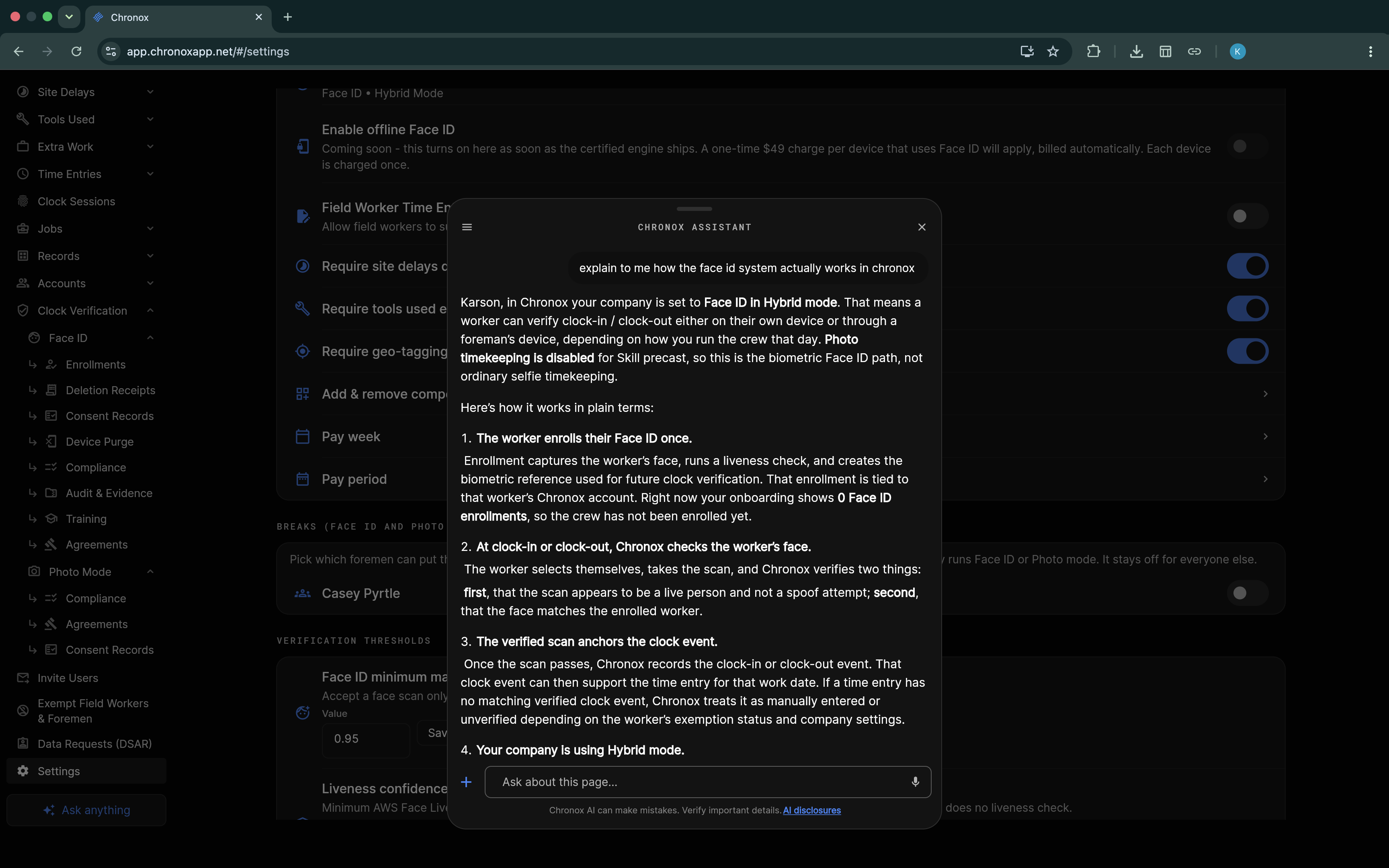
If you're allergic to AI slop, good - we are too. The Chronox assistant isn't just another ChatGPT wrapper claiming to be "Specialized AI." It's powered by an entire ecosystem of computing that starts with a deterministic engine computing every value in your organization. Then leading third-party AI models - Anthropic's and OpenAI's, contractually barred from training on your data and wired into Chronox's own construction workflows - summarize that data, show you where to improve the business, and create and edit the records you ask for - time entries, daily logs, jobs, cost codes - one time or on a repeated schedule, within what your role already allows.
You select your favorite model, then put it to work in plain English: "Every Friday, sweep the week for unbilled extra work." It runs, it reports, and it never touches money or payroll on its own: Chronox prepares, you approve.
Need to dig? Ask. Every answer shows you the punch, the rate, or the ticket it came from

The other apps take a picture. Chronox takes a side - yours.
How Chronox Face ID is built - matching runs on an enterprise-grade recognition engine, an independent server-side anti-spoofing check runs at the punch, and face templates stay encrypted in an isolated per-company collection on SOC 2 / ISO 27001-audited cloud infrastructure
Every claim above is checkable: pricing and docs cited at the bottom of this page
And the fundamentals, done right.
Consent built in
Workers e-sign a biometric consent before their first scan. Templates are encrypted math, never photos. When someone leaves, the template is destroyed and a deletion receipt goes on file. Never sold.
Tracks the clock, not the person
GPS is stamped at the punch. No breadcrumb trail between punches, no after-hours tracking, no batteries dead by lunch.
Breaks that hold up
Meal and rest breaks to the exact minute, flagged short, missed, or late against your state's rules - records that end wage disputes before they start.
Works in dead zones
Punches record offline, run the face check on the device, and sync when signal returns. Ships with the iOS and Android apps.
The face-ID stack behind it
The matching behind every punch runs on an enterprise-grade recognition engine, with your company's face templates held in their own isolated collection. An independent server-side anti-spoofing check runs at the punch - on an image sent with no name attached - and templates stay encrypted in transit and at rest on SOC 2 / ISO 27001-audited cloud infrastructure.
Payroll-ready exports
Approved hours to a payroll file in one click, OT and DT weighted, shaped for the system you already run: Gusto, QuickBooks, Square, BambooHR and OnPay - or plain CSV for anything else.
A view for every role
Foreman, accounting, management, admin - each gets its own view and a built-in walkthrough.
Full audit trail, fully exportable
Every change, who made it, and when - plus every punch, job, rate, and payroll line out as plain CSV, any day you want it.
Per-seat pricing punishes you for hiring.
To get time tracking plus job costing for a 20-man crew, here's what the field actually charges (as of July 2026):
No base fee. No admin license. No annual prepay. No implementation fee. No per-seat anything - hire man #21 through #30 and the price doesn't move.
Against any competitor on that list, the lifetime license pays for itself in under a year. Every month after is free.
Three ways in. One flat price.
Every plan covers your whole crew. None of them charges per seat.
✓Everything Chronox is and becomes: verified time clock, job costing, AI assistant, all future updates
✓One company, up to 30 active field workers
✓Priority suggestions
✓Never billed again
Two months free vs. paying monthly
✓Everything in Chronox
✓Whole crew, up to 30
✓$198 a year less than paying monthly
The "prove it to me" plan
✓Everything, nothing gated
✓No contract, cancel anytime
No hardware. No IT project. No hostage data.
Chronox runs on the phones already in your trucks. The foreman's phone or a site tablet is the clock; offline dead-zone punching ships with the mobile apps. Payroll comes out shaped for the systems you already run - Gusto, QuickBooks, Square, BambooHR and OnPay - and your complete records export to plain CSV whenever you ask. If you ever leave, you leave with your books.
Over 30 workers? $6 per additional worker per month.
Offline Face ID: $49 one-time activation on every device that uses it.
The questions a contractor actually asks.
What happens to my crew's biometric data?+
Before anyone's first scan, they e-sign a biometric consent right in the app: built in, not paperwork we leave to you. What's stored is an encrypted mathematical template, not a photograph; it's used for exactly one thing - verifying that the person punching is the person on payroll - and it's deleted automatically when you remove a worker, with a deletion receipt on file. Never sold - and shared only with the vetted infrastructure and security providers that perform the verification and hold the records, each one named in our sub-processor list (including the anti-spoofing provider, which gets the punch-moment image with no name attached and deletes it within 90 days), plus where the law requires it. Chronox is designed to support state biometric laws like Illinois BIPA, with the consent and retention pieces already wired in. Full details in the privacy policy and sub-processor list. What's doing the work: matching runs on an enterprise-grade recognition engine, your company's templates sit in their own isolated collection, an independent server-side anti-spoofing check runs at the punch, and SOC 2 / ISO 27001-audited cloud infrastructure sits underneath.
What if the jobsite has no signal?+
That's what the iOS and Android apps ship with: punch anyway, the face check runs on the device, and the scan, time, and GPS sync once you're back in coverage. The web clock still needs a connection - and a foreman can always key a missed punch in seconds, flagged for office review. Offline Face ID is a one-time $49 activation on every device that uses it - and one licensed tablet in kiosk mode covers a whole crew.
Do all my guys need to download the app?+
No. The foreman's phone or a site tablet works as the clock; the crew just looks at the camera. No apps to install, no passwords to forget, no badges to leave in the truck. And if you'd rather crews punch from their own phones, self-scan mode does that too - each scan pinned to that worker's own Face ID, so nobody clocks in a buddy from the parking lot.
What exactly does "lifetime" cover - and what if I grow?+
One company, all features, all future updates, and support, for as long as Chronox exists - up to 30 active field workers. Past 30 it's $6 per additional worker per month. You're never forced onto a different plan, and a growing crew never gets locked out of the clock.
Is the Chronox assistant just a normal chat bot?+
No - and that's by design. Every dollar figure comes from a deterministic engine doing analysis on your own punches, rates, and estimates, and each figure must trace to a defined metric before it reaches your screen. The assistant can also do work for you, one time or on a recurring schedule - but only what your own role already allows. Say "Set up a new job for the Riverside remodel," and it drafts the job record and asks for anything missing. It creates and edits records like jobs and cost codes for roles that already carry that permission, but it never files a foreman's entries - time entries, daily logs, extra work - on its own; those always come from a person. Foremen and field workers get it in answer-only mode, and it never sets pay or runs payroll on its own - those are prepared as a draft for a person to approve. It is still AI, so check its work before you rely on it.
How is this different from QuickBooks Time, busybusy, ClockShark…?+
Most of them just record time. Chronox tells you if the job's making money. One - identity, not a photo: QuickBooks Time, busybusy and ClockShark snap a selfie a manager eyeballs later; nobody matches it to the man. Chronox matches the face with an anti-spoofing check at the punch, and won't take a punch it can't match - a foreman clears the exceptions. Two - job costing that's already on: no higher tier, no QuickBooks sync, every punch on its cost code and estimate live. Three - extra work and change orders, plus equipment and tools, that go unbilled: Chronox logs them with detailed records ready for invoice. None of those three do - that's your margin walking off. Four - a real assistant: ask it which job's over or if payroll's clear, and it answers off your own numbers - the dollar figures come from a deterministic engine, not from the model. It is still AI and can get the words around a number wrong, so check it against your records. It runs your weekly report, drafts daily logs, and executes real tasks only when you say so. Five - one flat $99 for the whole crew, while theirs climbs every time you hire.
How fast can we actually start?+
Same day. Add your jobs and your crew, and the first punch works. Each role gets a built-in walkthrough on first login. Your next payroll period can close out of Chronox.

25 licenses at this price. Then it goes up for good.
$1,995 once, $990 a year, or $99 a month flat. Verified time clock, job costing, an agentic AI assistant, and much more - on every plan.
Limited
Questions? info@chronoxapp.net - we answer.
¹ Buddy-punching figures: Nucleus Research (≈2.2% of gross payroll); TSheets/Pollfish survey, 2017 (16% admission). ² Competitor pricing from vendors' published pricing pages and help docs, July 2026 - tier shown is the cheapest including job costing. Corrections: info@chronoxapp.net.